Saturday, June 11, 2011
DEBTOCRACY- A GREEK FILM WITH LESSONS FOR IRELAND
An important film with a profound analysis of the EU debt crisis which has a particular relevance for Irish viewers, we are currently in some form of extended honeymoon for the FG/Labour government. In a haze of relief at seeing the back the FF gang, the Irish people are in a state of suspended animation, wowed by visits from the Queen of England and President Obama, and following a spate of funerals for leading honourable politicians, creating the effect of disarming false national unity, there is a summer ahead for us in Ireland, akin to the 'phony war' period the early stages of World War II in Britain. People know theres a crisis going on and looming larger and larger, but theres a sense that in some way its in some way gone away. The IMF has deliberately contributed to this with the repeated assurance that we 'are on track' by which it means we have only just BEGUN the process Greece has been on for a lot longer. This sense of inevitability and supine trust in Fine Gael/ Labour is encouraged by their politicians constant reference to the terms of the EU/IMF deal 'negotiated' by the previous administration, ie for that read 'we're stuck with it..nothing we can do about it'.
Labour lead by Gilmore could not be more pliable and passive, they have disarmed the trade unions appetite for resistance by a coded promise to 'watch the backs' of the trade union heavy public sector, when the hawks in the Dept of Finance, and Fine Gael, go for the welfare system and the pay of all workers in public sector jobs in December...Meanwhile the phony war goes on, with Labour and Fine Gael softening up a punch drunk Irish public for a merciless whipping at the end of 2011, convincing us with week after week of propoganda, that we in some way 'deserve' the pain...A sort of warped utilization of vestigial remnants of Roman Catholic guilt...
The article below appeared recently in the UK Guardian, and it in turn alerted me to the film which is worth watching for anyone in Ireland, as they say in Greece, Ireland is only six months behind us...I fear that despite all the spin about our 'Export Success', there is a lot more that unites us with Greece and Portugal, than distinguishes us from them...This is despite Pat Kenny making the ludicrously childish assertion that we in Ireland are the 'best boy in the class'...What this film shows is that in a classroom where the IMF/ECB "teacher" is the educational equivalent of a sadistic Christian Brother on acid, being the 'best boy' is no guarantee of fair treatment
"One might not expect a butcher in rural Greece to recognise Costas Lapavitsas. He is, after all, an economist, a professor at the School of Oriental and African Studies in London. His research interests include the evolution and function of the Japanese financial system and his books include The Political Economy of Money and Finance – probably not staples of discussion among rural Greek butchers.
But when, just before Easter, the Lapavitsas went shopping for groceries in Kopanos ("A godforsaken village," apparently, "ugly as hell"), said butcher spotted his name. "I know of a Costas Lapavitsas," he said. "I have seen him in a video on the internet." On being told that video star and customer were one and the same, the butcher responded with more excitement than is desirable from someone wielding a cleaver: "Ah, Debtocracy!"
Lapavitsas does have a star turn in Debtocracy, a film whose success is as unlikely as the academic's celebrity. It's a documentary about the financial crisis that has struck Greece; the collapse of public finances; the €110bn loan from Europe and the International Monetary Fund; and the savage spending cuts to come.
Unlike other entries to the nascent credit-crunch movie genre, the film-makers do not go looking for guilty men and women. No Inside Job, this. Instead what you get is a polemic against the European system; an explanation of how Greece was always doomed to struggle against the likes of Germany. "So are we the black sheep of an all-successful Europe?" asks the voiceover. "Or has the system been ailing since its youth?"
Debtocracy makes a compelling case that the entire euro system was rotten from the start, with bankers in Frankfurt and Paris left with piles of surplus cash, and southern Europeans getting by on cheap loans. Made on a budget of €8,000 (£7,110) and with very little flashy camera work or fancy use of archive, this is still – I can confidently say, without delving too far into history – the best film of Marxian economic analysis yet produced.
Stuck up on a website and YouTube in early April, Debtocracy has garnered something close to a million views and has been broadcast on small Greek television channels, gradually building an audience. "At first, it was young Greeks with broadband connections," says Aris Chatzistefanou – who co-wrote and co-directed the film with Katerina Kitidi. "But then we heard stories of how small villages were screening it, and how old men in the countryside were asking their sons to download it on to DVDs." In the process, the film has become an artefact in the popular resistance to the austerity package imposed on Greece – and across southern Europe. In Portugal, the Left Bloc put on a showing of Debtocracy in a small cinema to launch its recent election campaign. The film was also scheduled to be screened to 4,000 protesters in Barcelona's Plaza Catalunya before the authorities broke up proceedings.
When I speak to Chatzistefanou, he is still recovering from showing his film in the central Syntagma square in Athens. The screening only got going at 2.30am "and then the audience wanted to discuss it. We still had 400 people arguing over the Greek financial crisis at five in the morning."
Timing has a lot to do with Debtocracy's success. Greece's economy has sunk deeper into crisis, buttressing the film's argument that the nation is being broken, not fixed, by the IMF and the eurozone. Yet the film's suggestion that Greeks should renegotiate, and refuse to pay some of its ruinous debts, still barely features in mainstream Greek politics or media. Which leaves one video on the internet to be passed around a swelling band of dissenters.
After returning from Kopanos to London, Lapavitsas received an email: "Greetings from the village!" began the butcher. "I just want to congratulate you on your film. When you come back we can have a proper discussion."


Thursday, December 9, 2010
One Irishman in Canada expressing shocking candour
Irresistable in his candour....A not uncommon view all over Ireland today
Thursday, November 25, 2010
Ireland in crisis: the stories they're not telling you - by Brian Whelan

Ireland in crisis: the stories they're not telling you
By Brian Whelan
Ireland's economic and political crisis has continued to develop at such a pace that many stories are being entirely missed by the nation's media.
Discontent with RTE has reached a new high after its decision to cut away from a live broadcast on Sunday night when TV3's Vincent Browne began to ask tough questions of the Taoiseach in front of the world's media.
Along with 80 official complaints, RTE's Facebook page has been filled with thousands of comments from angry viewers who say they have been forced to switch to BBC News 24 and Sky News to watch ‘unbiased' reports on the bailout. Some users have gone so far as to liken the state broadcaster to the Soviet Union's official mouthpiece Pravda.
See now: RTE's Facebook page
Former RTE director of television Helen O'Rahilly criticised the station for cutting away during a report on a matter of such ‘historical importance'. They dropped the ball again the following day with no live coverage of the Green Party's press conference announcing general election plans.
An incident later on Sunday night where an 18-year-old Dubliner was knocked down, allegedly by a minister's car, was only considered newsworthy by the Belfast Telegraph. The teen was rushed from the scene to hospital where he was X-rayed for a suspected broken leg.
Read now: Belfast Telegraph
The following day a rowdy protest at Government buildings saw Sinn Féin supporters enter the gates, only to come under attack from baton-wielding motorcycle garda.
What the garda may have failed to notice while striking out and grabbing one protestor by the throat, is that he was manhandling Aengus O'Snodaigh, an elected member of the Dáil who should be free to pass through the gates as he wished."
Deputy Ó Snodaigh can be seen in footage broadcast by the BBC and later spread across YouTube trying to calm the situation and move the protestors back outside the gate for their own safety.
While Green Party TD Paul Gogarty's bizarre decision to bring his child to
 the Green Party press conference on Monday was the subject of lively debate on Liveline yesterday, many news outlets missed the storm he has been creating on Twitter.
While the nation was falling into economic and political chaos, deputy Gogarty was using his Twitter account to bicker with members of the public, who were calling on him to pull out of government.
The deputy's tweets have provoked much controversy, not least because he has chosen to block scores of critics - including high profile reporters, elected representatives and academics.
David Cochrane, head of the politics.ie discussion forums, came in for particular scorn, being dubbed ‘master of the online pit of scurrilous vipers'.
See now: Paul Gogarty's Twitter page
Many Internet users are outraged at the ‘failure' of RTE to be critical of the government's bailout plans and have begun to distribute articles from smaller news sites and even foreign newspapers via social networking sites.
Dean Baker, writing in the Guardian, has suggested Ireland learn from the lesson of the IMF's involvement in Argentina and make a break from the euro, stating that if Ireland ‘plays by the bankers' rules, [it] will lose'.
Read now: The Guardian
Meanwhile Matthew Lynn, writing for Bloomberg, believes that Ireland would be better off going bust rather than taking a loan, as the conditions attached ‘aren't worth it'.
Read now: Bloomberg
Veteran reporter Vincent Browne has called the government a ‘junta' led by an ‘IMF minder' and claims ‘Saving banks to pursue a low-paid jobs policy is par for the course given the dysfunctionality of our rulers' ideology'.
Read now: Politico
These critical o
 pposition voices are missing in a country where the debate is reduced to guessing how long the current government will last before the next government steps up to implement the IMF-led cuts in a nicer way.
This Friday's by-election will act as a barometer of the nation's mood, but surely the biggest test will be the ICTU march on Saturday, where the countless armchair critics who demand ‘why is there nobody on the streets' will have their day.
The Technical Engineering and Electrical Union have now officially called for ‘civil disobedience' to bring the government down and hope to build on this weekend's protests. Their general secretary has declared ‘we are on the brink of significant civil unrest in this country'.
Read now: The TEEU site
The only protest being mentioned in the media however is a ‘silent protest' organised by a comedian via Twitter, where people are urged to bring placards telling the government they're fired - though this is surely missing the point that if they were listening to public opinion they would have fled weeks ago.
On the other end of the spectrum the emergence of a new right wing grouping in Ireland has failed to inspire much interest. It brings together economics journalist Marc Coleman, former Libertas PR man John McGuirk and Iona Institute director David Quinn.
The group hopes to end civil war politics and introduce a European left-right political system here and despite their unfortunate name - National Alliance - they are progressive right unlike their extremist ‘white power' American namesakes.
Read now: National Alliance
Are you fed up with how the country is being run or how the bailout is being reported?
We are and thats why we welcome the formation of the United Left Alliance.......
March to GPO against the IMF/EU Sellout and Cuts. Sat 27th Nov.
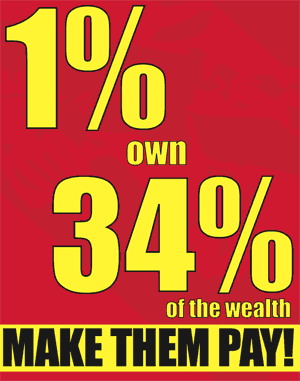 | This march is supported by a wide range of groups. Please come out and show your support! Assemble 12 noon, on November 27th at Wood Quay, Dublin The ICTU have called for the march on Sat but it is only on the basis of 'fairer' cuts. But we shouldn't accept this. See the statement from the 1% Network on the analysis of the problem. It would seem the unions were co-opted long ago and serve to allow political pressure to be vented safely by making token gestures of opposition. Ignore the govt spin that tries to focus on those relying on social welfare or those working in the public service. These are all designed to redirect the focus and anger away from the bankers, developers and speculators and challenge it amongst the masses to prevent any fightback. "Fascism should more properly be called corporatism because it is the merger of state and corporate power." - Benito Mussolini.. |
Saturday, November 6, 2010
Cows With Guns....Very very funny
Whilst the hiatus created by the posting and then sudden pulling on youtube of John Websters youtube video of John Leppers poem about Jarama continues I thought I would put up a little known but in my opinion very funny song indeed.
click on http://www.youtube.com/watch?v=FQMbXvn2RNI
Apologies for those who came looking for the Jarama clip which featured a number of my own photos of the battlefield in Jarama, but it seems to have been pulled off youtube for some reason.
Song By Dana Lyons
Animation by Bjorn-Mange Stuestol
All credit to them, links to their site at the end
Monday, October 4, 2010
F*** the lot of yeh.....Bertie Ahern...from milking the Celtic Tiger to licking its Nauseating Litter Tray...

He was always the man of the people, quaffing a pint with the lads at Fagans, eschewing any interest in the trappings of power. BUT Behind the well cultivated image, Bertie Ahern , former Taoiseach of Celtic Tiger Ireland, was always deeply deeply interested in money. So much so that he claimed the 'artists' exemption from paying tax on the sales of his recent 'memoirs'. He also is entitled to a permanent driver and car for life, and will be accompanied by a Garda driver for the rest of his days, as well as being in receipt of his Prime Ministerial, index linked, pension, from the day he resigned the post, this despite the fact he is still in receipt of his handsome salary as a TD (or member of the Irish Parliament). His love of money has now taken him to the point of appearing in an advert for the Irish version of Rupert Murdoch's 'News of the World' where he now appears as a regular 'sports columnist'. He appears crouched in a kitchen press, and appears as the house owner opens his cupboard door. I can think of another enclosed space that a lot of people would like him consigned to, a space with a lot thicker and more durable walls than a cupboard...
Apparently he did it for 'the cráic' (the fun of it), he is just a japester and a barrel of laughs is'nt he?? He did'nt fiddle whilst Rome burnt, but its good to see someone seems immune to concerns about dignity of office, and what a former taoiseach and sitting TD will do to garner a few extra grubby notes..
Sinn Féin TD Aengus Ó Snodaigh has called for the ending of the perk which provides two salaried secretaries to former Taoisigh, including Bertie Ahern. Deputy Ó Snodaigh was commenting on the controversy over the former Taoiseach’s participation in a tv ad for his News of the World column.
Deputy Ó Snodaigh said:
“The sight of Bertie Ahern’s head appearing in a kitchen press has caused amusement to some and disgust to many. His venture into tv advertising to promote his column in the News of the World adds to his already tarnished political reputation.
“The serious side of this, though, is that the State is paying very generous pensions and perks to former Taoisigh, including Bertie Ahern.
“Last June it was revealed in reply to a Sinn Féin Dáil Question that the Department of the Taoiseach is paying salaries to secretarial assistants employed by four former Taoisigh, including Bertie Ahern.
“As a TD, Bertie Ahern is already entitled to salaries for a parliamentary assistant and a secretarial assistant. But according to the current Taoiseach’s reply, Deputy Ahern also benefits from the former Taoisigh scheme by having the salaries of two secretarial assistants paid for up to five years after his retirement as Taoiseach, and the salary of one secretarial assistant indefinitely after five years.
“In Deputy Ahern’s case the secretarial allowance amounted to €114,000 in 2009 alone.
“This lavish expenditure on former Taoisigh is in addition to their very generous pensions and the State cars and Garda drivers at their disposal.
“Home help hours for elderly citizens are being cut and we must ask how many such hours would this scheme pay for? It should be ended and the funds made available for a useful purposeThursday, September 30, 2010
Anglo Cement Lorry Protester Morphing into Hero in an Ireland Seething with Pent-UP Fury
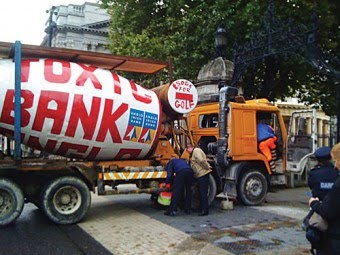
Yesterday was the opening day of the Dáil, our Parliament, once a revolutionary institution set up as an alternative centre of democratic power in Ireland before the British state relinquished political control of Ireland. Nowadays the Dáil is widely derided by the people of Ireland as the soiled and festering bed of parasites, gougers, shoneens, gombeens, and gobshites who run this poor benighted country. So as a result I have'nt heard anything but sympathy for the man who rammed the gates the Dáil building y
 esterday morning with a cement lorry, covered with slogans protesting about how the debts of Anglo-Irish bank being shouldered by the people of Ireland is grinding this country and its people into a morass of unemployment and sovereign debt that this state will be paying off for generations.
The cost of bailing out Anglo Irish Bank, the lender at the centre of Ireland's financial crisis, could rise to €34bn (£29.1bn) under a worst case scenario, the Irish central bank admitted today. The news came as the country's finance minister warned that the failure of the nationalised bank would "bring down" Ireland, and warned of further austerity measures.
In an interview with the Financial Times, Brian Lenihan said Ireland had no choice but to act. "Any Anglo failure would bring down the sovereign. It is systemically important not because of any intrinsic merit in the bank, I can assure [you] I don't see any. But because of its size relative to the national balance sheet. No country could contemplate the failure of such an institution," he said."The soaring costs of supporting the Irish banking system will cause the government's budget deficit to rise to 32% of gross domestic product this year, Finance Minister Brian Lenihan said in his statement on Thursday.The EU limits only permit a deficit to reach 3% of GDP ideally....That estimate places the deepest deficit for any euro-zone country since the launch of the shared currency in 1999. Ireland, like other fiscally weakened countries such as Greece and Portugal and Spain, has been struggling to imposed radical spending cuts and tax increases to close budg et gaps without triggering another recession.
What really infuriates people here is that....
i) the bankers and their cronies who brought the country to ruin are still swanning around Ireland and the world apparently completely immune to prosecution..Michael Lynn the lawyer who shafted €40 million off of his clients is sunning himself in the Algarve apparently without seemingly a care in the world. Sean Fitzpatrick the former boss of Anglo would have the courts believe he is on €188 a month when he continues to live a millionaire lifestyle.. (see seanie golfing pic) A lifefestyle he is enjoying courtesy of his wife who seems to have ready access to millions surprise surprise....seen here driving that battered old vehicle ...There is a widespread feeling that these creatures are beneficiaries of a discreet web of protection from the highest levels of gombeenism in this disfunctional (even by capitalist standards) state.
ii) The so called 'small people' who owe money or who protest are pursued with the full force of the state, the Anglo Avenger cement lorry driver is to be charged by the Director of Public Prosecutions with criminal damage, and no doubt fined heavily or even imprisoned. A young man made jobless in the crisis was jailed for failing to pay a €240 euro fine, he was released only when his father drew attention to this on the Joe Duffy liveline programme on RTE radio 1
People here are angry, but they have'nt got a focus to trigger a mass response. the organised trade union movement grew scared at the strength of workers responses to the few days of action organised in the Spring...the Trade Union bosses at SIPTU sold us out and signed a deal with government to stymie public sector resistance. The so called 'Labour Party' lead by ex-stickie Eamon Gilmore is so desperate to get into government they are not leading anything other than token verbal resistance. Quite frankly Sinn Féin seems paralysed and unimaginative and unwilling to mobilise mass protest.
Popular mass protests WILL erupt here, all that is required is the spark to ignite the blue touchpaper leading to the huge powder keg of anger waiting to explode....
European Workers Stir....Resistance is on the Agenda
 Derek Kotz in Brussels, in Morning Star, Wednesday 29 September 2010
CLEAR MESSAGE: Protestors walk past a billboard which reads: 'No to austerity' during a demonstration in Brussels on Wednesday
The halls of EU power in Brussels trembled to the footsteps of more than 100,000 workers on Wednesday as they converged from across Europe to reject crippling austerity cuts.
Trade unions and activists representing 24 countries brought the city to a standstill as they snaked their way through the streets with a thunderous march that ended in a rally at the Esplanade du Cinquantenaire park.
As Spanish workers staged a general strike and Greek rail staff walked out over privatisation, the common call in a multitude of languages was for co-ordinated action against the biggest attack on Europe's working class since the 1930s.
A sea of banners proclaimed that workers would not be forced to pay with their jobs and services for a crisis caused by the unmitigated greed of bankers.
Banners and flags from RMT, PCS, NUT, TSSA, CWU, Napo, Unite and Usdaw were prominent among a noisy British contingent.
Brussels police were out in force, barricading the entrance of every bank in the city as well as the European Commission headquarters. But the massive event passed peacefully.
As the day of action - called by trade union umbrella organisation ETUC - took place outside, the EU Commission announced a package of proposals to crack down on hard-pressed member states, threatening them with huge fines if they failed to run their economies "efficiently."
Speaking to the Star from the rally, RMT leader Bob Crow condemned dangerous EU moves to impose centralised caps on public-sector pay and sanctions against member states deemed not to be cutting deep or fast enough.
"Workers across Europe face the same threat to jobs, public services and pensions, and that threat originates from exactly the same source - the centralised banks and the political elite who do their bidding," he explained.
Twinings Usdaw convenor Pete Millward emphasised the importance of public and private sector workers struggling together against the cuts, warning that the British government's plans to cut 600,000 public sector jobs would also mean "700,000 private sector job losses."
And he rubbished government claims that there was no alternative.
Unison youth delegate Gerry Cowell, a musician outreach worker from Colchester, was proud to be on the march alongside other workers and pensioners.
"It is important for us all to unite to oppose cuts wherever and to make our protest locally, nationally and acros Europe," she told the Star.
FBU national officer Dave Green hailed the "fantastic turnout" saying that it showed "the enormous level of resistance to austerity measures that governments will face."
He added: "Economies across Europe have been brought to the verge of collapse by the out-of-control greed of bankers."
Portuguese union UGT international officer Wanda Guimaraes made the point that workers "draw their strength from unity.
"Today's demonstration shows the trade union movement is a huge family that is united against cuts and poverty and against non-inclusive societies."
She stressed that unions had a responsibility to lead the fight to save services and jobs across the continent.
Organised pensioners across the continent also joined the march, with Dot Gibson of the British-based National Pensioners Convention stressing: "It is important for pensioners to link up with the union movement in opposing the cuts and attacks on workers pensions."
She said she was looking forward to a meeting next week with French, Italian and Spanish pensioners' organisations held in Paris to discuss their united response to the cuts.
Cedric Mahu of France's CGT union, which had 10,000 delegates on the march, said he would be on strike again on October 12 in his country's national strike against attempts by the Sarkozy government to take the hatchet to French workers' pensions.
Subscribe to:
Posts (Atom)